Signed in as:
filler@godaddy.com

Musician, Innovator, & Founder
At just 18 years old, Caleb Van Brunt is a Cello Performance major at Azusa Pacific University who brings a unique perspective to 3D instrument design. His work lies at the intersection of classical craftsmanship and cutting-edge 3D printing technology. A versatile multi-instrumentalist, he was a co-winner of the 2024 CYSO Concerto Competition and maintains a deep commitment to community service, regularly volunteering his talents with the San Antonio Regional Hospital’s Music Therapy Program. While highly accomplished on the cello, he is exceptionally well-rounded, with proficiency in piano, viola, voice, clarinet, and both alto and tenor saxophone.
Driving Innovation: Ultimate 3D Solutions
Beyond the concert hall, Caleb translates his deep understanding of acoustic performance into high-precision engineering. As the Founder and CEO of Ultimate 3D Solutions, he leverages additive manufacturing to push the boundaries of design, prototyping, and functional production. His firsthand experience with the physical mechanics of string and wind instruments gives him a unique edge in developing 3D-printed instruments and accessories like his Chair Tilt that bridge the gap between traditional craftsmanship and modern technology.
Global Communication & Education
In addition to his technical and musical pursuits, Caleb is a dedicated linguist fluent in English, Spanish, and Mandarin Chinese, and American Sign Language (ASL). Recognizing the power of structured, efficient systems, he founded Chinese in a Day and authored a book by that title detailing a practical, accelerated framework for achieving Mandarin fluency.
Whether refining his language skills, mastering a complex score, or engineering the next generation of 3D-printed instruments, Caleb Van Brunt is defined by a relentless drive for precision, innovation, and sharing his passions with the world.
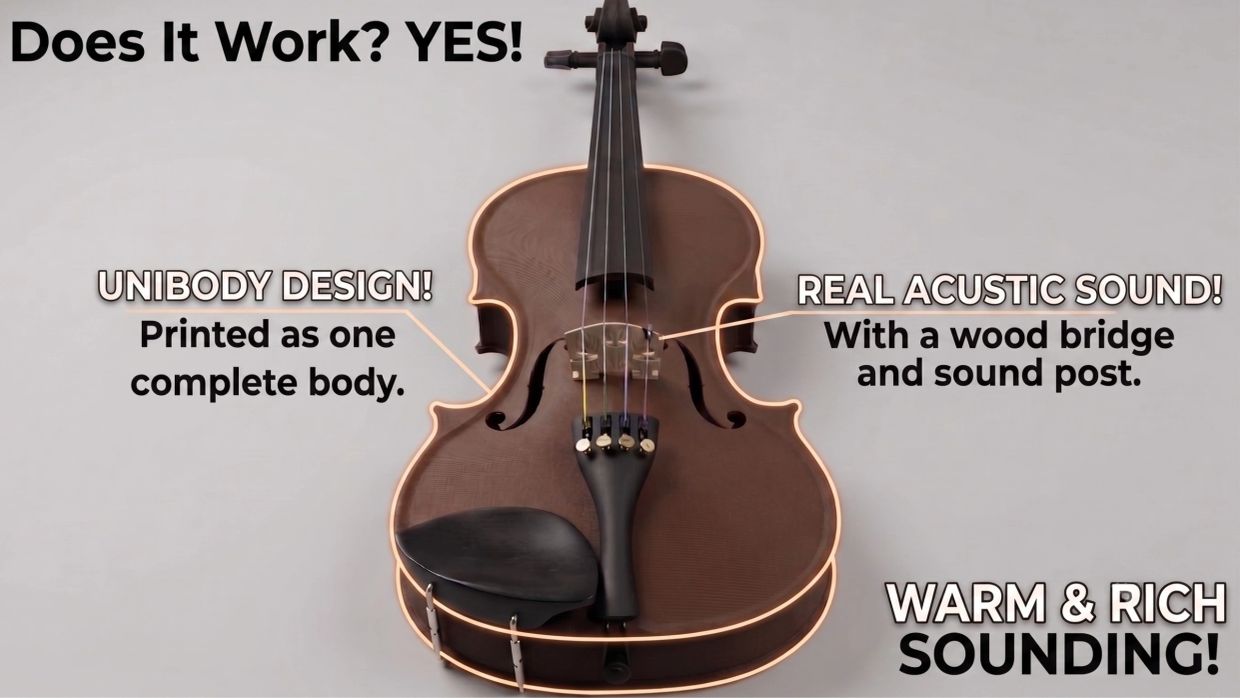
The Amani 3D-Printed Violin: Expanding Access to Music Education
The traditional violin is a refined acoustic instrument, but its cost, fragility, and inconsistency at the entry level can create barriers for beginners. The innovative 3D instrument design of the Amani violin is not intended to replace classical craftsmanship but is aimed at addressing key challenges in early music education: affordability, student retention, and global accessibility.
Lowering the Cost Barrier
For many families, starting a child in music involves significant expense. Traditional beginner violins are either costly to purchase or require rental agreements that quickly exceed the instrument’s value. If a student stops playing early, much of that investment is lost. Through additive manufacturing, 3D-printed violins reduce this barrier by utilizing digital designs and affordable polymer materials. This enables schools and programs to produce instruments at a significantly lower cost, transforming the violin into a more accessible entry point rather than a burdensome financial commitment.
Improving the Beginner Experience
Many entry-level instruments suffer from inconsistent manufacturing quality, which can make learning unnecessarily difficult. Low-cost factory violins often struggle with tuning stability and tonal quality due to variable materials and construction. This can discourage beginners, as the real issue often lies with the instrument itself. The precision offered by 3D printing leads to a more stable structure that holds tuning better and provides consistent feedback, allowing students to focus on developing their techniques rather than compensating for equipment issues.
Expanding Global Access
In many regions, access to properly made instruments is limited. Students frequently rely on improvised alternatives that lack standardized dimensions. Without consistent sizing and ergonomics, establishing proper hand positioning and muscle memory becomes challenging for advanced study. A 3D-printed violin can be produced locally wherever a printer is available, using the same digital file, which creates a standardized learning tool that can be replicated across schools, libraries, and community programs worldwide.
Durability for Educational Use
Unlike traditional wooden instruments, polymer-based 3D-printed violins are highly resistant to environmental changes and physical impact. They are less likely to crack, warp, or require frequent adjustment, making them well-suited for classroom environments and younger students. Innovators like Caleb Van Brunt are leading this movement towards 3D instrument design, ensuring that music education is more inclusive and supportive.